
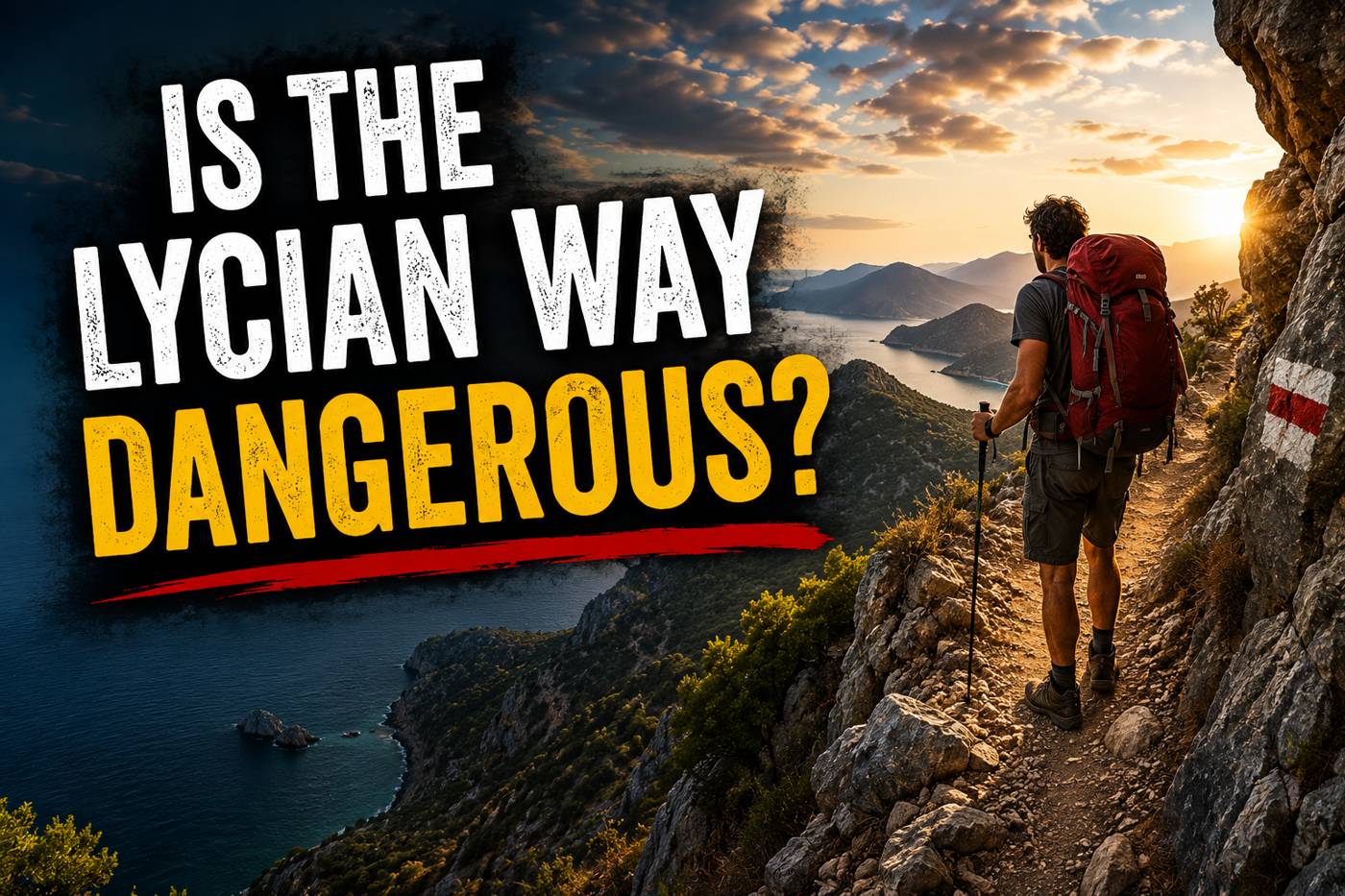
Is the Lycian Way Dangerous?
It is one of the first questions people ask when they start planning a trip to the Lycian Way.
And it is a fair question. The trail runs along remote clifftops above the Mediterranean. It crosses mountain ridges far from any town. It passes through areas with no phone signal and, in places, no water source for hours at a stretch.
So: is it dangerous?
The honest answer is: not particularly — if you are prepared. And more dangerous than it looks — if you are not.
Here is a realistic, no-nonsense guide to the actual risks on the Lycian Way and how to manage them.
The Good News First
Let’s start with what you are probably most worried about: personal safety.
The Lycian Way is, by any reasonable measure, a very safe trail. Turkish people are very welcoming and crime against hikers is almost non-existent. Most of the risks come from the environment and the heat.
Robberies, attacks, and violence against hikers are extremely rare — rarer, in fact, than in most Western cities. The communities along the trail are accustomed to hikers passing through and are, almost without exception, hospitable and helpful.
Turkey has a reputation in some quarters that does not reflect the reality on the ground for visitors. Hikers on the Lycian Way consistently report feeling safe, welcomed, and well looked after.
That said, there are genuine risks on this trail. They are just not the ones most people worry about.
The Real Risks on the Lycian Way
1. Heat and Dehydration
This is the most serious and most underestimated risk on the Lycian Way.
The Turkish Mediterranean coast is genuinely, seriously hot between June and September. The sun is intense. The trail frequently passes through exposed terrain with no shade. And the rocky limestone surface reflects heat upward as well as receiving it from above.
Dehydration on the Lycian Way can become dangerous quickly — especially on sections where water sources are scarce or have dried up in the summer months.
Water is the biggest challenge on the Lycian Way. In the spring, you will find plenty of small streams and village taps, but if you are hiking in the autumn, many of those sources can dry up completely.
The rule experienced Lycian Way hikers follow: carry more water than you think you need. Always. On remote sections, carrying four litres per person is not excessive.
Starting very early — before sunrise if possible — and resting during the hottest hours of the day is essential in summer. Hiking in the midday heat between July and August is not just uncomfortable. It is genuinely risky.
2. Terrain and Twisted Ankles
The Lycian Way is not generally a dangerous or technically challenging trail. There are lots of ascents and descents which can certainly tire you out, and the trail surface is frequently rugged and uneven, but you are not exploring the caldera of an active volcano or climbing the North Face of the Everest.
That said, rugged, challenging footpaths in many parts make it necessary to watch your footing carefully. Twisted ankles are not unusual, especially during the first few days before you acquire your Lycian Way groove.
The trail surface varies enormously. Some sections are smooth and well-maintained. Others involve sharp limestone rocks, loose scree, steep descents, and root-crossed forest paths.
Good hiking shoes — not trainers, not sandals — are essential. Trekking poles make a significant difference on the steeper sections, taking pressure off your knees on the descents and providing stability on uneven ground.
The most important thing: slow down. Most ankle injuries happen when hikers are tired and moving too fast. The Lycian Way rewards patience.
3. Getting Lost
The trail is marked with red and white painted waymarks. On popular sections, these are frequent and clear. On more remote stretches, they can be faded, obscured by vegetation, or simply absent where the path has changed.
Despite good intentions, most hikers get lost at some point nearly every single day.
Getting briefly lost on the Lycian Way is almost a rite of passage. Getting seriously lost — following the wrong route for hours into remote terrain with no water and no phone signal — is a genuine risk without proper navigation.
A reliable offline mapping app with current GPX tracks (OsmAnd or Gaia GPS are the recommended options) is essential for self-guided hikers. A physical map as backup is wise. And a guide who knows the trail eliminates the problem entirely.
4. Fire Risk
Forest fires are a very serious danger in Turkey. Do not start any campfires and be very careful with your stove. In the summer, many forest areas are closed because of the fire risk.
This is not a theoretical risk. Forest fires are a real and recurring danger in the Turkish mountains, particularly in July and August. Hikers must take this seriously — no open fires, extreme caution with camping stoves, and awareness of any local restrictions during high fire-risk periods.
If you are not sure whether an area is under fire restrictions, ask locally before setting up camp.
5. Wildlife
The Lycian Way does not have large predators. There are no bears, wolves, or anything that poses a serious threat to hikers.
But there are a few things worth knowing about:
Southern Turkey does have scorpions and they are definitely present along the Lycian Way. Caution should be used when sitting down on rocks and, if you are camping, around your campsite. Shake out your boots before putting them on.
Scorpion stings are painful but rarely life-threatening for healthy adults. The precautions are simple and become second nature quickly.
Dogs can be a nuisance and are occasionally aggressive, but just wave your hiking poles at them menacingly and they will usually leave you alone — most are just warning you off from the livestock they are supposed to be protecting.
Snakes are present but rarely seen. If you do encounter one, give it space and move around it calmly. The vast majority of snakes in the region are non-venomous, and even the venomous species are not aggressive.
6. Remote Sections and Emergency Access
On some sections of the Lycian Way, you are genuinely remote.
In an emergency, you can call 112 but it might take a few hours before help arrives in remote areas. Since phone reception is often missing, carrying a satellite communicator is a smart idea.
The emergency number in Turkey is 112 for all services. But on remote sections, there may be no signal to make the call, and response times can be long.
For self-guided hikers on remote sections, a satellite communicator — a device that sends GPS location and emergency messages without mobile signal — is a sensible precaution. For hikers on guided tours, this risk is significantly reduced by the presence of a guide who knows the terrain and the emergency protocols.
Who Should Be Cautious
The Lycian Way is described as a moderate trail overall. But moderate does not mean suitable for everyone without qualification.
Hikers should take extra care if they:
- Have no previous experience with multi-day hiking
- Are not comfortable with heights — the trail frequently passes along cliff edges with significant exposure
- Are hiking alone, particularly on remote sections
- Are visiting in July or August without experience of hiking in extreme heat
- Have any significant knee, ankle, or cardiovascular health concerns
None of these are reasons not to hike the Lycian Way. But they are reasons to plan carefully, choose an appropriate section, and consider whether a guided option makes more sense than going independently.
How to Reduce the Risks
Most of the risks on the Lycian Way are manageable with good preparation.
Start early every day. Dawn starts mean the hardest walking is done before the heat peaks. This is the single most effective safety measure in summer.
Carry enough water. Always more than you think you need. On sections with no reliable water source, carry four litres per person minimum.
Wear proper footwear. Hiking boots or trail running shoes with good grip and ankle support. Not trainers. Not sandals.
Use trekking poles. Particularly valuable on steep descents. They protect your knees over a long trip and provide stability on uneven ground.
Download offline maps. OsmAnd with current GPX tracks from the Culture Routes Society is the most reliable navigation option. Do not rely solely on phone signal.
Tell someone your route. Let your guesthouse — or a contact at home — know which section you are walking each day and when you expect to arrive.
Hike with a guide. A good local guide eliminates most of the navigational risks, knows where the water sources are, can read the weather, and handles emergencies with experience. For first-time Lycian Way hikers, this is the most effective single risk-reduction measure available.
Final Thoughts About The Is the Lycian Way Dangerous?
The Lycian Way is not a dangerous trail.
It is a trail that requires respect, preparation, and awareness of the environment you are moving through.
The hikers who get into difficulty are almost always the ones who underestimated the heat, carried too little water, wore the wrong shoes, or relied on an out-of-date map on a remote section.
The hikers who have the time of their lives — which is the vast majority of people who walk this trail — are the ones who prepared properly, started early, slowed down when the terrain demanded it, and trusted the people around them.
For thousands of hikers who walk the Lycian Way each year, it is a living museum of Anatolia’s past and a sanctuary of Mediterranean wilderness.
It is also one of the most rewarding and beautiful trails in the world.
With the right preparation, it is absolutely within reach.
Explore our guided Lycian Way tours — the safest, most rewarding way to experience this extraordinary trail.

Comment (0)