
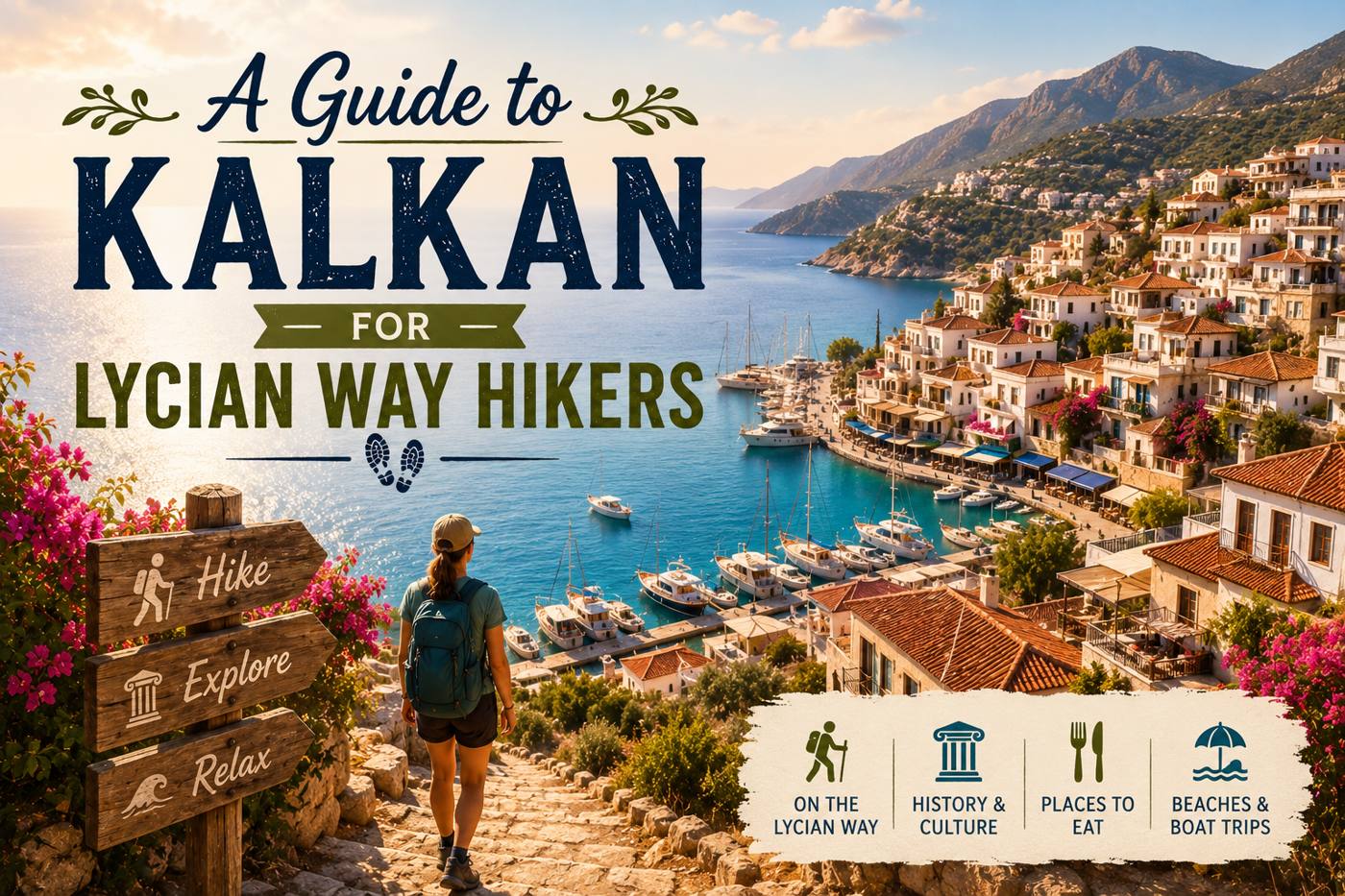
A Guide to Kalkan for Lycian Way Hikers
There are towns on the Lycian Way that you pass through.
And then there is Kalkan.
Kalkan is the kind of place that stops you. Not because it demands your attention — it is too understated for that. But because everything about it is quietly, precisely right. The white-washed houses spilling down the hillside. The rooftop restaurants above the harbour. The bougainvillea. The bay so blue it makes you doubt your eyes.
Most hikers arrive in Kalkan tired. Most leave wishing they had stayed longer.
Here is everything you need to know.
Where Kalkan Sits on the Lycian Way
Kalkan sits on the western section of the Lycian Way, between Patara to the west and Kaş to the east — approximately halfway through the first and most popular section of the trail.
This placement makes it a natural stopping point. Hikers arriving from the Patara and Letoon direction have usually covered some of the trail’s most historically rich terrain. Those heading east toward Kaş are moving into some of its most dramatic coastal scenery.
Kalkan is the pause between two extraordinary chapters.
The section arriving into Kalkan from Patara is particularly rewarding — passing through the ruins of ancient Patara, across the edge of its famous beach, and up into the hills with views over the bay that get better with every metre of elevation gained. The town appears below you gradually, growing more beautiful the closer you get.
What Makes Kalkan Different
Kalkan has managed something that very few Turkish coastal towns have achieved: it has embraced tourism without losing itself to it.
The old town — a hillside neighbourhood of narrow cobbled streets, Ottoman-era houses, and small squares — remains genuinely charming. Cars are largely absent from the upper streets. The pace is slow. The restaurants are good.
It is also, compared to some of its neighbours, slightly more upmarket. Kalkan attracts a loyal following of repeat visitors — many of them British — who return year after year for the rooftop dining, the sailing, and the particular quality of light on the bay in the evenings.
For hikers arriving on foot after days on the trail, it is an extraordinarily welcome contrast.
Things to Do in Kalkan
Walk the Old Town
Give yourself a morning to simply wander.
The old town climbs the hillside above the harbour in a tangle of narrow streets and stairways. Ottoman houses with wooden balconies overhang the lanes. Small shops sell local honey, olive oil, and handmade goods. Cats occupy every available surface.
The harbour at the bottom of the hill is small and pretty — fishing boats alongside sailing yachts, a waterfront promenade, cafes with tables facing the water.
At dusk, when the light turns gold and the boats rock gently in the harbour, Kalkan is one of the most beautiful small towns on the Turkish coast.
Kaputaş Beach
A short distance east of Kalkan — reachable by dolmuş or on foot along a section of the Lycian Way — lies Kaputaş Beach.
It is one of the most photographed beaches in Turkey, and one of the most striking. A narrow gorge cuts through the cliffs and opens onto a small crescent of sand at the water’s edge. The sea here is a particularly intense shade of turquoise, framed by the rock walls on either side.
The descent to the beach involves a long staircase from the road above. It is worth every step.
On a clear day, the colour of the water at Kaputaş is almost surreal — the kind of blue that makes you wonder if you have stumbled into a place that was designed rather than natural.
Boat Trips
Kalkan is an excellent base for boat trips along the surrounding coastline.
Daily excursions run to nearby coves, sea caves, and swimming spots that are inaccessible by road. The coastline around Kalkan is spectacular — deep bays, limestone cliffs, hidden beaches — and seeing it from the water gives a perspective that no amount of hiking can replicate.
A full-day boat trip from Kalkan, with several swimming stops in clear turquoise water, is an excellent way to spend a rest day between trail sections.
The Delikkemer Aqueduct
A short distance from Kalkan, the remains of a Roman-era aqueduct — the Delikkemer — cross a valley in remarkable preservation.
The aqueduct carried water to the ancient city of Patara, and sections of it are directly on the Lycian Way between Patara and Kalkan. Walking past it — or stopping to look at the engineering properly — is one of those moments on the trail where the scale of Roman infrastructure becomes suddenly, vividly real.
A stone water channel, two thousand years old, still standing in the hillside above a Turkish coastal town.
Patara and Letoon
Kalkan is the ideal base for day trips to two of the most significant ancient sites on the Lycian Way.
Patara — the birthplace of Saint Nicholas and capital of the Lycian League — lies a short drive or a half-day walk from Kalkan. The ruins are extensive, the beach is extraordinary, and the combination of ancient history and natural beauty makes it one of the finest days out in the region.
Letoon — the sacred sanctuary of the Lycian League, dedicated to the goddess Leto and her divine twins Artemis and Apollo — is a UNESCO World Heritage Site alongside Xanthos. The ruins include three temples and a nymphaeum (monumental fountain), and the site has an atmosphere unlike anywhere else on the trail — quiet, slightly melancholy, and very beautiful.
Both sites are comfortably visitables as day excursions from Kalkan, either independently or as part of a guided tour.
Where to Eat in Kalkan
Kalkan has a reputation — well-deserved — for some of the best rooftop dining on the Turkish coast.
The restaurants above the harbour offer views over the bay and out to sea that are as good as anything you will find on the Lycian Way. In the evening, with the lights of the harbour below and the dark Mediterranean beyond, dinner in Kalkan is an occasion worth dressing for.
Fresh fish is excellent and Kalkan specialises in seafood mezze — small plates of octopus, shrimp, sea bass, and local catches served alongside fresh bread and cold drinks.
Meze spreads — hummus, haydari (yoghurt with herbs), sigara böreği (crispy cheese pastries), stuffed vine leaves — are the right way to start any meal in Kalkan.
Breakfast at a rooftop cafe with views over the bay is one of the genuine pleasures of stopping here. Take your time with it. The trail will wait.
For a more local experience, the smaller restaurants in the backstreets above the harbour consistently outperform the waterfront tourist spots. Ask your guesthouse for their recommendation.
Where to Stay in Kalkan
Kalkan offers accommodation ranging from simple family pansiyons to boutique hotels with infinity pools overlooking the bay.
For Lycian Way hikers, the most useful accommodation sits in or just above the old town — close enough to the harbour to enjoy the evenings, and well-positioned for an early morning departure toward Kaş the following day.
Boutique hotels in Kalkan tend toward the higher end of the Turkish coastal market — comfortable, characterful, often with rooftop terraces and sea views. They are more expensive than pansiyons but offer a significant step up in comfort.
Pansiyons in and around the town offer simpler rooms, usually with breakfast included, and often with the warmth and local knowledge that only a family-run guesthouse can provide.
Booking ahead is essential between May and October. Kalkan is one of the most popular destinations on the Turkish coast with European visitors, and accommodation fills early — particularly the better boutique hotels.
Getting to and from Kalkan
Kalkan is well connected by road, making it a practical arrival or departure point for hikers joining or leaving a section of the Lycian Way.
By air: The nearest airport is Dalaman, approximately 1.5 hours by road. Private transfers can be arranged through accommodation or tour operators. Antalya Airport is approximately 3 hours away and serves a wider range of international routes.
By bus: Regular bus services connect Kalkan with Fethiye (approximately 1.5 hours) and Antalya (approximately 3 hours). Dolmuş services run frequently to nearby Kaş and Patara throughout the day during the season.
On foot: The Lycian Way enters Kalkan from the west via the Patara and Delikkemer aqueduct section, and leaves eastward toward Kaş through the hills above the town. Both sections are well-marked and manageable.
The Best Time to Visit Kalkan
April and May are ideal — warm enough to swim comfortably, not yet at peak summer heat, with the hillsides green and the wildflowers still out. The town is busy but not overwhelmingly so.
June is excellent. The sea is warm, the evenings are long and beautiful, and the summer crowds have not yet arrived in full force.
July and August are the busiest and hottest months. The rooftop restaurants are full every evening, accommodation prices peak, and the bay is busy with sailing boats. Hiking in the midday heat requires careful planning — very early starts are essential. The town is at its most vibrant but also its most crowded.
September and October are arguably the finest months of all. The summer crowds thin, the temperatures ease, the sea is at its warmest, and the evening light on the bay in autumn is extraordinary.
Final Thoughts About The A Guide to Kalkan for Lycian Way Hikers
Hikers who stop in Kalkan for one night often find themselves wishing they had planned for two.
There is something about the combination — the quality of the light, the harbour below, the rooftop dinner, the knowledge that you have walked here on your own two feet from somewhere remarkable — that makes it genuinely difficult to leave in the morning.
The trail east toward Kaş is beautiful. The views from the hills above Kalkan looking back over the bay are some of the finest on the entire trail.
But first: one more morning in that rooftop cafe, coffee in hand, looking out over the water.
The Lycian Way will still be there when you are ready.
Explore our Lycian Way tours based around Kalkan and the western section of the trail and see why this stretch is one of our favourites.

Comment (0)