
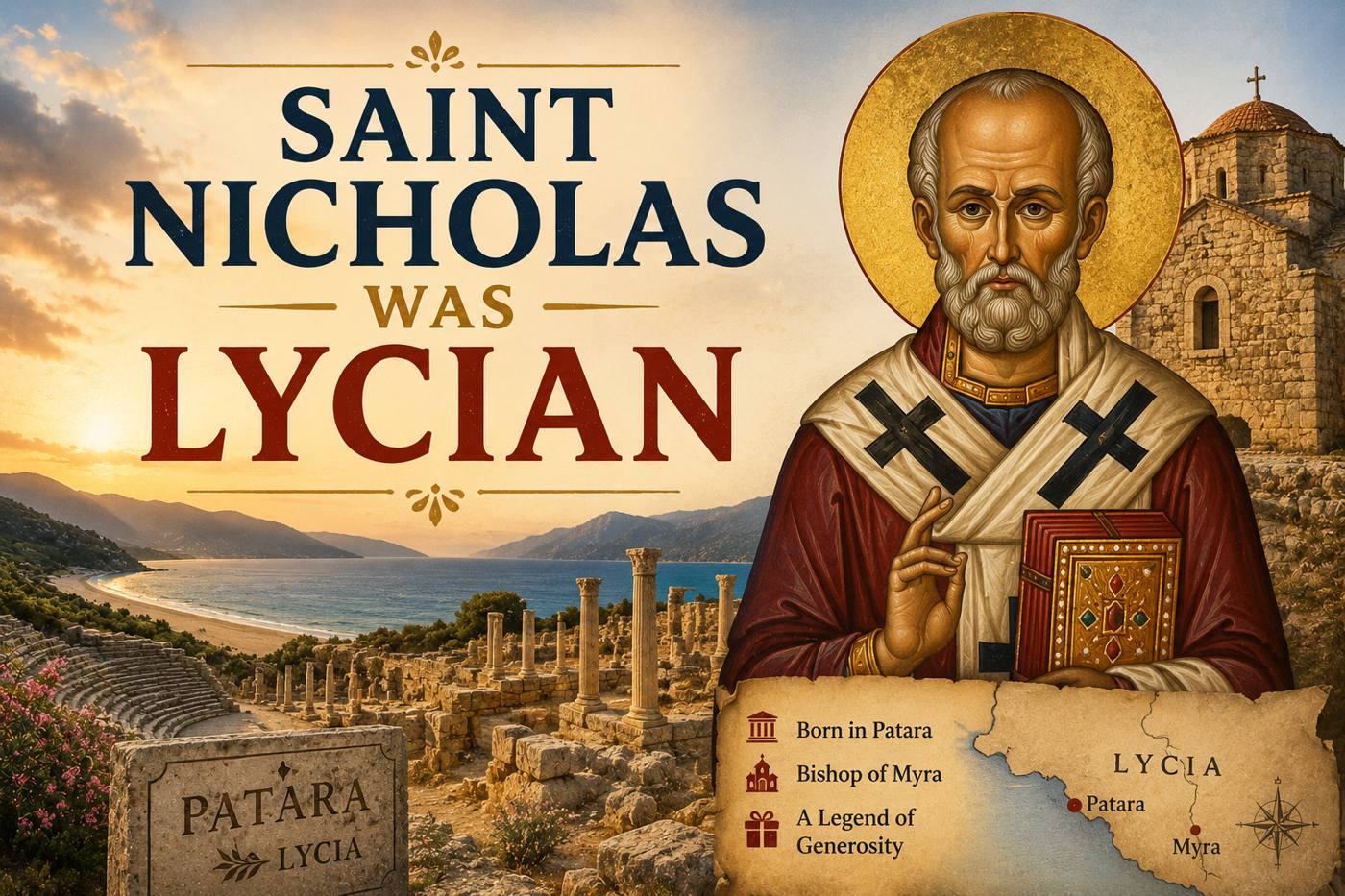
Saint Nicholas Was Lycian: The Real Story Behind Santa Claus
You are walking through the ruins of an ancient city.
Sand dunes have swallowed most of it. A Roman theatre emerges from the ground ahead of you, remarkably intact. A wide beach stretches beyond the ruins to the sea.
This is Patara — capital of the Lycian League, home to Europe’s longest beach, one of the great cities of the ancient Mediterranean world.
It is also the birthplace of Santa Claus.
Not the red-suited, reindeer-riding figure of Christmas cards. The real one. The historical person behind the legend — a fourth-century bishop whose acts of extraordinary generosity created a tradition of secret gift-giving that has outlasted his civilisation, his language, his empire, and almost everything else from his world.
His name was Nicholas. He was Lycian. And his story begins right here, on the trail you are walking.
Born in Patara
Nicholas was born sometime after the year 260 in the important harbour city of Patara, in the Greek-speaking Roman province of Lycia, in what is now southwestern Turkey along the Mediterranean coast.
At that time Patara’s population was about 15,000. It enjoyed sea trade but also relied on cottage industries — food processing, textiles, pottery, metalwork. It was a prosperous, cosmopolitan port city — the kind of place where merchants from across the Mediterranean world came and went, where ideas and goods moved freely, where a wealthy family could give their son an excellent education.
Nicholas was born to wealthy Christian parents. His family had money — significant money — and when his parents died young, he inherited it.
What he did with that inheritance is where the story begins to get interesting.
The Gold and the Three Sisters
The most famous story about Nicholas — the one that, seventeen centuries later, still shapes the tradition of leaving gifts in stockings on Christmas Eve — takes place in Patara.
In one of the earliest and most famous incidents from his life, he is said to have rescued three girls from being forced into prostitution by dropping a sack of gold coins through the window of their house each night for three nights, so their father could pay a dowry for each of them.
The detail that matters: he did it secretly. He threw the gold through the window at night, anonymously, so the family would not know who had helped them.
On the third visit, the weather was particularly cold and the window was closed. So Nicholas climbed onto the roof and dropped the gold down the chimney — whereupon it fell into the youngest daughter’s stockings, hung up to dry over the stove.
Stockings. A chimney. A secret gift in the night.
The echoes are not subtle.
Bishop of Myra
Nicholas was eventually appointed bishop of nearby Myra, another Greek-speaking port city in the Lycia province.
Myra — the ruins of which sit just inland from the modern town of Demre, directly on the Lycian Way — was one of the most important cities in Lycia. Its extraordinary cliff face of carved rock tombs, stacked above a well-preserved Roman theatre, is one of the most dramatic sights on the entire trail.
Nicholas was imprisoned and likely tortured during the persecution of Christians by the Roman emperor Diocletian, but was released under the rule of Constantine the Great. He survived to see Christianity go from an illegal religion, persecuted by the state, to the preferred faith of the Roman Empire.
He is included in lists of the more than 300 bishops from across the Christian world who gathered in the year 325 at the Council of Nicaea — the great church council that established core Christian doctrine and produced the Nicene Creed.
A bishop from a small city on the Turkish coast, sitting at one of the most consequential meetings in the history of Christianity.
What He Was Known For
The modern pop culture Santa evolved from stories about Bishop Nicholas of Myra, who was revered for centuries because of his selfless generosity, good deeds, and love of others, especially children.
He used his great wealth to relieve all who were in need: families, widows, orphans, and children. As bishop, he founded a poorhouse, hostels, and a hospital.
He was also, according to tradition, a protector of sailors — praying to calm a storm at sea during a pilgrimage voyage — which is why he became the patron saint of seafarers. Appropriate, perhaps, for a man born in one of Lycia’s great port cities.
He is one of the patron saints of children and sailors, as well as the patron saint of Greece and Russia, and of merchants, bakers, brides, and the falsely accused. The breadth of his patronage reflects the breadth of his reputation — a man known across the ancient world for showing up when people needed help most.
After His Death: The Bones Go to Italy
Nicholas died in Myra around 343 AD. He was buried in the church where he had served as bishop — a building that still stands in modern Demre, now known as the Church of Saint Nicholas, and is one of the most visited Christian pilgrimage sites in Turkey.
For seven centuries, his tomb in Myra drew pilgrims from across the Byzantine world.
Then, in 1087, things took a dramatic turn.
A group of merchants from the Italian city of Bari removed the major bones of Nicholas’s skeleton from his sarcophagus in the church without authorisation and brought them to their hometown, where they are now enshrined in the Basilica di San Nicola.
The theft — because that is what it was — had an unexpected consequence. Bari became one of the most important pilgrimage destinations in medieval Europe. The cult of Saint Nicholas spread westward, carried by the merchants and sailors who venerated him. His feast day, December 6th, became a major occasion for gift-giving across Europe.
The Lycian bishop’s legend was now global.
From Saint Nicholas to Santa Claus
The journey from fourth-century Lycian bishop to red-suited Christmas icon is a long and winding one.
The Feast Day of Saint Nicholas has been celebrated widely across Europe for centuries, including in the Netherlands, where the saint is known as Sinterklaas.
Dutch settlers brought Sinterklaas to America. The name was anglicised to Santa Claus. The physical appearance — the red suit, the white beard, the jolly demeanour — was gradually shaped by nineteenth-century writers and twentieth-century advertisers into the figure recognised everywhere today.
The specific image of Santa coming down the chimney with gifts? That traces directly back to the story of Nicholas throwing gold through a window in Patara — and the lucky accident of it landing in a stocking hung up to dry.
A fourth-century act of anonymous generosity on the Lycian coast, retold for seventeen centuries, reshaped by folklore and commerce into one of the world’s most recognisable figures.
Where to Visit on the Trail
Patara
The ruins of Nicholas’s birthplace are directly on the Lycian Way.
The ancient city of Patara is extensive and largely unexcavated — sand dunes have covered much of it, which means new discoveries continue to be made. The excavated areas include a monumental gateway, a colonnaded street, the council chamber of the Lycian League, and a Roman theatre.
The beach at Patara — over 18 kilometres of uninterrupted sand, car-free and protected as a turtle nesting site — is one of the finest on the Mediterranean coast.
Walking through the ruins of the city where Nicholas was born, knowing what he would become, is one of those moments on the Lycian Way that stays with you.
Myra (Demre)
The ancient city of Myra, near the modern town of Demre, is where Nicholas served as bishop and where he was buried.
The cliff tombs above the Roman theatre at Myra are among the most spectacular on the entire trail — a honeycomb of carved facades stacked above each other on a sheer rock face, looking out over the ruins of the city below.
The Church of Saint Nicholas in Demre, about a kilometre from the ancient theatre, is one of the most historically significant Christian sites in Turkey. The building dates in its current form largely to Byzantine rebuilding in the eleventh century, but it stands on the site of the church where Nicholas served and was buried. Mosaics and frescoes survive inside.
A bronze statue of Saint Nicholas stands outside the church. He is depicted not as Santa Claus but as what he actually was: a bishop, in robes, with a kind expression — a man from this coast who decided to give away everything he had.
Final Thoughts About The Saint Nicholas Was Lycian
Most people spend their whole lives celebrating the legend of Saint Nicholas without knowing where he came from.
He came from here. From the coast you are walking. From cities whose ruins you are passing through.
He was born in a port city that now lies under sand dunes beside a beautiful beach. He served in a city overlooked by extraordinary cliff tombs. He was buried in a church that still stands, in a town you can visit on foot.
The tradition of leaving gifts for children — the secret generosity, the night-time visit, the stocking — traces back to a specific act of kindness by a specific person, in a specific place, on this coast, seventeen hundred years ago.
The Lycian Way passes through the birthplace of one of the world’s most enduring stories.
It is worth stopping to think about that.
Explore our Lycian Way tours and walk through the land that gave the world Saint Nicholas.

Comment (0)