
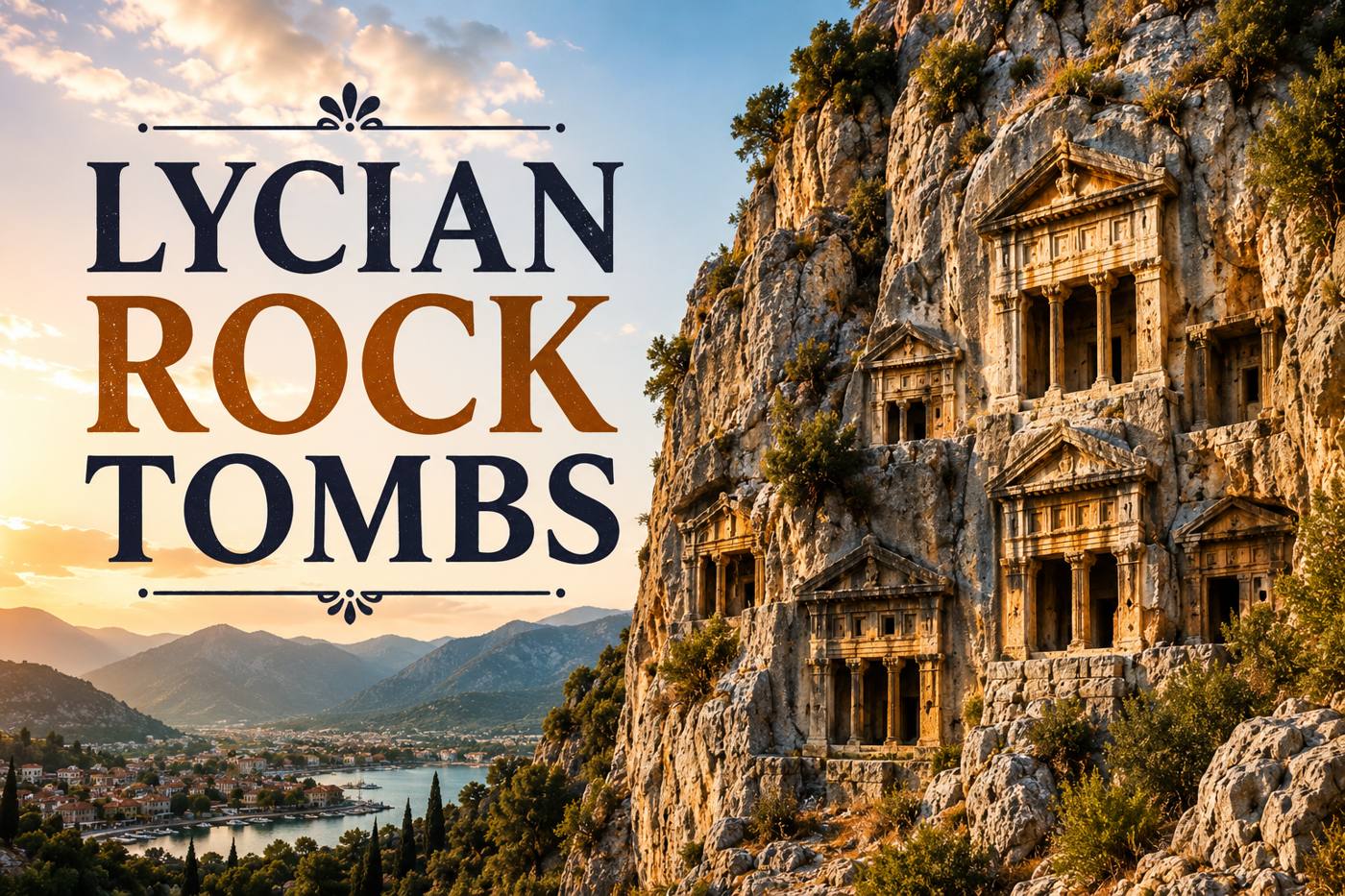
Understanding Lycian Rock Tombs | Why Are They So High Up?
You notice them before you understand them.
A shape in the cliff face that is too regular to be natural. Columns carved from living rock. A dark rectangular opening ten, fifteen, twenty metres above the ground.
You stop walking and look up.
How did they get up there? Why is it up there? And who is — or was — inside?
Lycian rock tombs are one of the most distinctive and mysterious features of the Lycian Way. They appear throughout the trail, sometimes announced by a sign, more often appearing without warning around a bend in the path or above a village rooftop.
Understanding them changes how you see the entire landscape.
What Are Lycian Rock Tombs?
Lycian rock tombs are ancient burial monuments carved directly into cliff faces and rock outcroppings across the region of Lycia — the southwestern corner of modern Turkey, through which the Lycian Way passes.
They were created primarily between the fifth and second centuries BC, during the height of Lycian civilisation, though some date to earlier and later periods.
They are not caves that were repurposed as tombs. They are purpose-carved monuments — architectural facades cut into the living rock with considerable skill and effort, designed to be both functional burial chambers and permanent, visible declarations of status and identity.
There are hundreds of them across Lycia. On the Lycian Way, you encounter them regularly — sometimes in clusters, sometimes alone on a remote clifftop, sometimes embedded so naturally into the landscape that you wonder how you almost walked past without noticing.
The Different Types
Not all Lycian tombs look the same.
Over the centuries, Lycian tomb architecture evolved through several distinct styles, each reflecting different periods and influences.
House Tombs
The earliest and most distinctly Lycian tomb style mimics the appearance of a wooden house — complete with carved beams, doors, and sometimes decorative details that replicate the construction techniques of Lycian timber architecture.
These tombs tell us something remarkable: the Lycians believed the afterlife required a home, and they built one accordingly. The tomb was not just a burial place. It was a dwelling.
Temple Tombs
As Greek influence spread through the Mediterranean world from the fifth century BC onward, Lycian tomb architecture absorbed Greek elements — particularly the classical temple facade with its columns, pediment, and decorative frieze.
The most elaborate temple tombs are architectural achievements of genuine sophistication. The famous Tomb of Amyntas at Fethiye — a vast Ionic facade carved into a cliff face above the town — is the finest example, but smaller versions appear throughout the Lycian Way.
Sarcophagus Tombs
Later in the Lycian period, freestanding sarcophagi became common — stone coffins raised on a base, often with a distinctive pointed lid and carved decorative panels.
These appear throughout Lycian towns and cities, sometimes in clusters, sometimes alone in a field or beside a path. The extraordinary sarcophagus in the middle of Kaş town centre — sitting calmly on a street corner while life moves around it — is one of the most striking examples on the trail.
Rock-Cut Chamber Tombs
The simplest form: a rectangular chamber cut directly into the rock face, sometimes with a carved facade, sometimes with nothing but a doorway.
These are the most numerous type and the ones you encounter most frequently on the trail — often in groups on a cliff face, sometimes stacked above each other, the higher ones seemingly impossible to reach without modern climbing equipment.
So Why So High Up?
This is the question everyone asks.
Stand below a cluster of Lycian tombs on a sheer cliff face and the engineering required to create them seems almost incomprehensible. No scaffolding. No power tools. No safety equipment. Just stonemasons, suspended somehow above a hundred-metre drop, carving elaborate facades into vertical rock.
Why go to that effort? Why not simply bury the dead at ground level?
Historians have proposed several explanations, and the honest answer is that more than one of them is probably true.
The Eagle Theory
The most poetic explanation — and one that fits what we know of Lycian religious beliefs — is that the tombs were placed high so that eagles could carry the souls of the dead to the heavens.
The eagle was a sacred bird in Lycian culture, associated with the gods and with the passage between the mortal world and the divine. Placing a tomb high on a cliff — at eagle height, closer to the sky — may have been a deliberate act of religious intent, positioning the dead for their journey upward.
Protection from Grave Robbers
A more practical explanation is security.
Lycian tombs were built to house not just bodies but valuables — gold, jewellery, weapons, objects of status that the dead might need in the afterlife. A tomb at ground level was a tomb that could be easily robbed.
A tomb twenty metres up a sheer cliff face was considerably less accessible.
Lycian tomb inscriptions frequently include curses against those who disturb the burial — suggesting grave robbery was a real and persistent concern. Height was one defence against it.
Flood Protection
The cities of Lycia were built in river valleys and coastal lowlands prone to seasonal flooding.
Placing tombs above the flood line — high on the cliff faces that overlooked the city — was practical as well as symbolic. The bodies of the dead, and the objects buried with them, would remain dry and undisturbed regardless of what the valley below experienced.
Visibility and Status
There is also the straightforward matter of being seen.
A tomb carved into a prominent cliff face above a city was visible to everyone in that city, every day, for generations. It was a permanent, indelible statement of a family’s wealth, status, and importance.
The higher and more elaborate the tomb, the greater the statement.
In a culture where the memory of the dead was taken seriously — Lycian tomb inscriptions often list the family members permitted to be buried inside, and threaten legal penalties as well as divine curses against those who violate the burial — visible permanence mattered enormously.
A tomb on a cliff face was harder to ignore, harder to demolish, and harder to forget than a grave in the earth.
How Were They Built?
The engineering of the high rock tombs remains genuinely impressive.
The most likely method involved cutting from the top down — beginning work from the cliff above and working downward, with workers suspended on ropes or temporary wooden platforms secured into the rock face.
Evidence of tool marks, unfinished tombs, and quarrying techniques visible on some cliff faces supports this interpretation.
The softer limestone of many Lycian cliff faces made carving more practical than it might appear — the rock could be worked with iron tools and shaped in considerable detail. Over time, the surface would harden and weather, giving the finished tombs the appearance of having always been part of the cliff.
Some of the more elaborate temple tomb facades involved months or years of work by skilled stonemasons — an investment comparable to constructing a substantial building.
What the Inscriptions Tell Us
Many Lycian tombs carry inscriptions — some in the Lycian language, some in Greek, some in both.
These inscriptions are remarkable documents.
They typically record the name of the person or family who commissioned the tomb. They specify which family members are permitted to be buried inside. They list the penalties — financial, legal, and divine — that will befall anyone who violates the burial or buries an unauthorised person in the tomb.
The level of legal and procedural detail in some inscriptions is extraordinary. These were not just memorial texts. They were legally binding documents, carved in stone so they could not be disputed or ignored.
Reading them — or reading translations of them — the people who built these tombs suddenly become specific and human. They had families they wanted to protect. They worried about being forgotten. They wanted the record of their existence to outlast them.
Two and a half thousand years later, standing below their tombs on the Lycian Way, we are proof that it worked.
The Most Remarkable Tombs on the Trail
The Tomb of Amyntas, Fethiye
The largest and most impressive rock tomb in Lycia — a vast Ionic temple facade carved into the cliff above Fethiye town. Dating from around 350 BC, it is visible from much of the town below. The interior burial chamber is accessible and the scale of the facade, seen from close up, is breathtaking.
The Cliff Tombs at Myra
The most dramatic concentration of rock tombs on the entire Lycian Way. An enormous cliff face above the ancient theatre at Myra is honeycombed with carved facades stacked above each other — dozens of tombs of varying sizes and styles, some with carved figures, some with faded paint still visible, all of them looking out over the valley below as they have for two thousand years.
The Painted Tomb at Myra
Among the Myra tombs, one preserves traces of the original painted decoration — reds, blues, and yellows — that once covered many Lycian tomb facades. Most of the paint has long since weathered away. This fragment gives a glimpse of how vivid and colourful the cliff face once appeared.
Pinara
The ancient city of Pinara features an extraordinary cliff face riddled with hundreds of simple rock-cut tombs — row upon row of rectangular openings carved into a sheer rock pillar that rises above the ruins of the city. The effect is unlike anything else on the trail — a cliff that is more tomb than rock.
The Sarcophagus in Kaş
Not high up — but unmissable. A monumental Lycian sarcophagus sits on a plinth in the middle of a street in Kaş town centre, completely integrated into everyday life. Cars park nearby. Cats sleep on its base. It has been there for two and a half thousand years and shows every sign of remaining there indefinitely.
Seeing Them With Fresh Eyes
Once you understand Lycian tombs — what they are, why they are where they are, who built them and why — you cannot walk past them without stopping.
Every tomb is a specific person, or a specific family, who stood in this landscape, looked out at this same sea, and made a decision about how they wanted to be remembered.
They chose height. They chose stone. They chose permanence.
They built something that has survived earthquakes, invasions, the collapse of their entire civilisation, and two and a half thousand years of Mediterranean weather.
And it worked.
You stopped. You looked up. You are thinking about them right now.
Explore our guided Lycian Way tours — our guides bring the history of the tombs and the trail to life at every step.

Comment (0)