
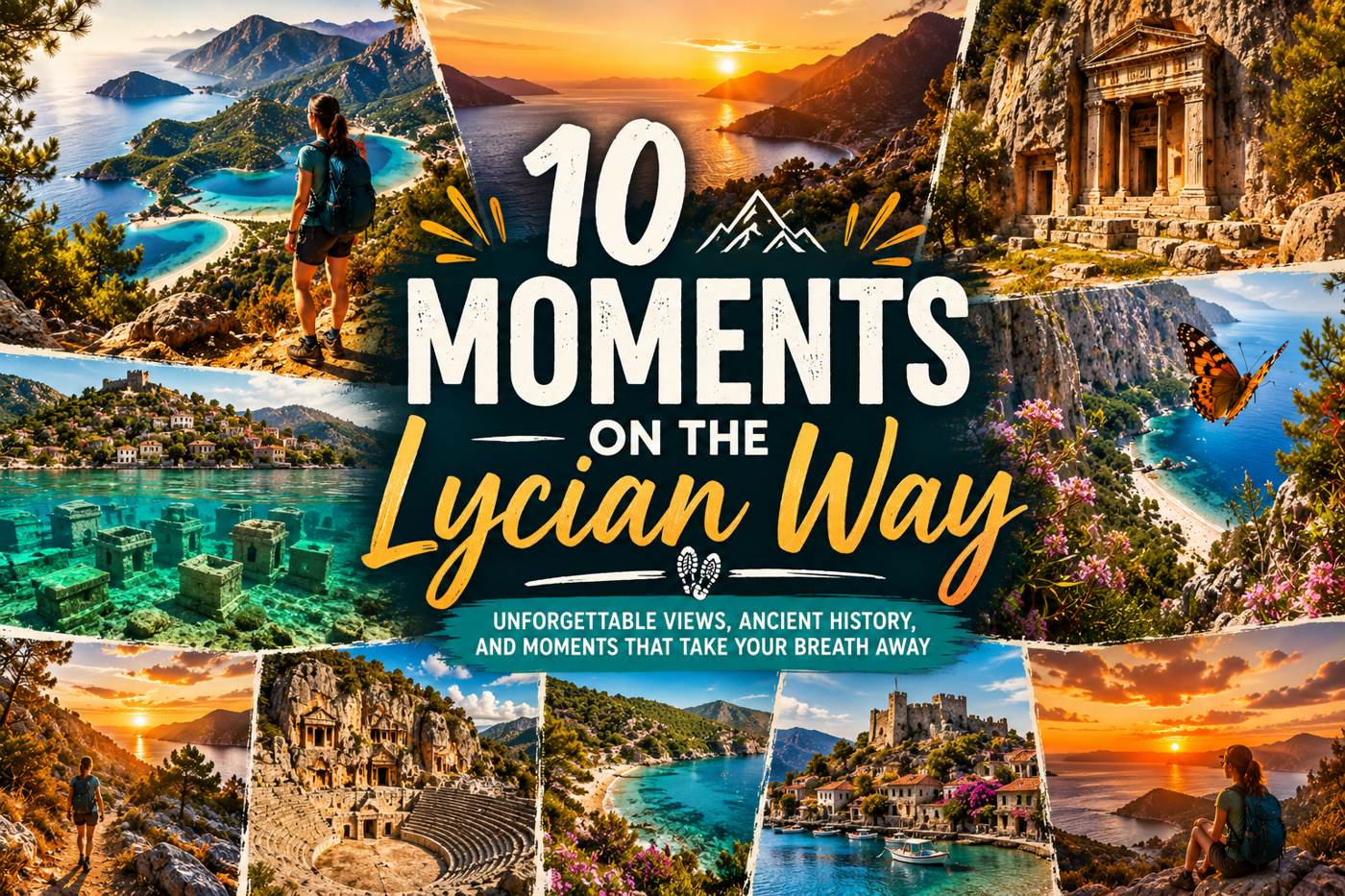
10 Moments on the Lycian Way That Will Stop You in Your Tracks
You will be walking the Lycian Way.
Head down, pack on, counting kilometres. Thinking about lunch or your feet or whether the guesthouse has hot water.
And then something will happen that makes you stop completely.
Not because you planned to stop. Not because your map says there is something here worth seeing.
Just because the world in front of you is suddenly so extraordinary that moving feels wrong.
It happens more on the Lycian Way than anywhere else.
Here are ten moments that do it to almost everyone.
1. Your First View of the Lagoon at Ölüdeniz from Above
You have probably seen the photographs.
The turquoise lagoon. The white pebble beach. The mountains reflected in completely still water.
The photographs are good. They are not enough.
The first time you see Ölüdeniz from the clifftop path above — appearing suddenly through a gap in the pine trees as you climb out of the resort and onto the trail — something happens that no photograph prepares you for.
The scale of it. The colour of it. The way the open sea beyond the lagoon stretches to the horizon while the water inside the channel sits perfectly still.
You stop. You stare. You take a photograph you already know will not capture it.
Then you keep walking, carrying that view with you for the rest of the day.
2. A Lycian Tomb Appearing Without Warning
You are on a narrow path through pine forest.
Nothing remarkable. Roots crossing the path, dappled light, the smell of resin warming in the sun.
And then you turn a corner and there it is.
Carved directly into the cliff face above you — ten, fifteen metres up — a fully formed tomb facade. Columns. Decorative carvings. An inscription in an alphabet you cannot read. Cut into living rock two and a half thousand years ago.
No fence. No sign. No ticket booth.
Just a tomb, in the forest, exactly where it was left.
The silence around it feels different from ordinary silence.
3. The First Morning Swim
It is probably day two or three.
You have been walking since dawn. The sun is fully up now, serious and hot. Your pack is heavy. Your legs know exactly how far they have come.
Then the path descends toward the coast and you see it — a small cove, completely empty, the water so clear you can see the bottom at five metres depth.
You do not discuss it. You do not check the map. You simply drop your pack, pull off your boots, and walk straight into the sea.
The cold hits you like a reset button.
Everything — the heat, the tiredness, the weight of the pack — disappears completely.
You float on your back and look up at the sky and the mountains and the pine trees and you think: I am the luckiest person alive.
4. Butterfly Valley from the Clifftop
The path approaches Butterfly Valley from above.
You do not see it coming. The ground simply disappears.
A gorge drops vertically from your feet — sheer rock walls plunging straight down to a narrow strip of beach far below. The valley is enclosed on three sides by cliffs. The sea fills the fourth side, impossibly blue.
In spring and summer, the air above the valley moves with butterflies.
You stand at the edge and look down and the scale of it takes your breath away. Not metaphorically. You actually exhale and forget to breathe in again for a moment.
5. Sunrise on the Trail
You set your alarm for 5am reluctantly.
You pull on your boots in the dark, questioning your decisions.
You step outside into air that is cool and completely still, the sky just beginning to turn at the edges, and start walking.
For the first twenty minutes, the world is grey and quiet and yours entirely.
Then the sun clears the mountains to the east.
The sea turns from black to deep blue to the colour of a flame. The cliff faces above the path go gold. The pine trees glow. A bird starts singing somewhere in the forest and then suddenly everything is singing.
You stop walking and stand completely still.
This is the world before anyone else has touched it.
6. The Sunken City at Kekova
The boat moves slowly along the northern shore of Kekova island.
You are looking at the surface of the water, not sure what you are looking for.
And then you see it.
Walls. Staircases. A doorway. Columns. The foundations of an entire city, lying two or three metres below the surface of the sea, perfectly visible through water so clear it barely seems to exist.
An earthquake in the second century AD cracked the coastline and the city slipped into the sea. It has been there ever since — untouched, undisturbed, slowly being explored by fish.
You hang over the side of the boat and stare down into someone else’s world.
7. Walking into Simena (Kaleköy)
Simena is not accessible by road.
The only way in is by boat from Üçağız, or on foot along the Lycian Way.
You arrive on foot, which means you arrive the right way — approaching through the hills, descending toward a tiny harbour, the village appearing below you like something from a dream.
A hundred people live here. Maybe fewer. A medieval castle sits above Lycian rock tombs. Bougainvillea covers white walls. Cats sleep on ancient stone.
Below the waterline, just offshore, the ruins of a sunken city are visible through the clear water.
You sit at a table by the harbour and order a cold drink and try to decide if this place is real.
8. The Theatre at Myra
You have seen theatres on the Lycian Way before.
But Myra stops you differently.
The theatre itself is remarkable — well preserved, substantial, the stone seating rising in a wide arc above a stage that is still largely intact. But it is what rises behind the theatre that takes your breath away.
A cliff face, honeeycombed with carved tomb facades stacked above each other like apartments, stretching the full width of the rock. Dozens of them. Some with carved figures still visible above their doorways. Some with inscriptions. Some ornate, some simple, all of them carved into the living rock by people who wanted to be remembered forever.
You stand in the theatre and look up at the tombs and the tombs look back at you across two and a half thousand years.
9. An Unexpected Village Welcome
You are tired. It is later in the day than you planned. The village you were heading for is still further than you hoped.
You pass through a tiny settlement — four houses, a tea garden, a dog sleeping in the road.
An old man is sitting outside. He sees you coming. He waves. Not a polite tourist-wave. A proper, come-here, sit-down wave.
You sit. He brings tea without asking. His wife appears with something to eat — bread, olives, tomatoes. She smiles and gestures for you to eat.
You do not share a language. You share the table, the food, the late afternoon light.
When you leave, an hour later than you planned, something has shifted. You cannot quite explain what.
10. The Last Evening on the Trail
You knew this moment was coming.
The final stretch of the last day is always bittersweet — the trail still beautiful, your body still moving, your mind already beginning the process of returning to ordinary life.
You arrive at your final guesthouse in the late afternoon.
You put down your pack for the last time. You sit on the terrace. Someone brings you something cold to drink.
The sea is below you. The mountains are behind you. The light is doing what the light on this coast always does at this hour — turning everything gold, softening every edge.
You sit very still.
You think about the tombs in the cliffs and the sunken city under the sea and the village man who gave you tea and the morning you stood on the ridge and forgot to breathe.
You think: I need to come back.
Everyone thinks this.
Everyone comes back.
Final Thoughts About The 10 Moments on the Lycian Way
It is not one moment. It is ten, twenty, fifty moments across seven days.
Moments that arrive without warning and stay with you long after you have left.
That is what the Lycian Way is, underneath the distance and the elevation and the logistics.
A trail that keeps stopping you.
In the best possible way.
Explore our Lycian Way tours and start collecting your own moments.

Comment (0)