
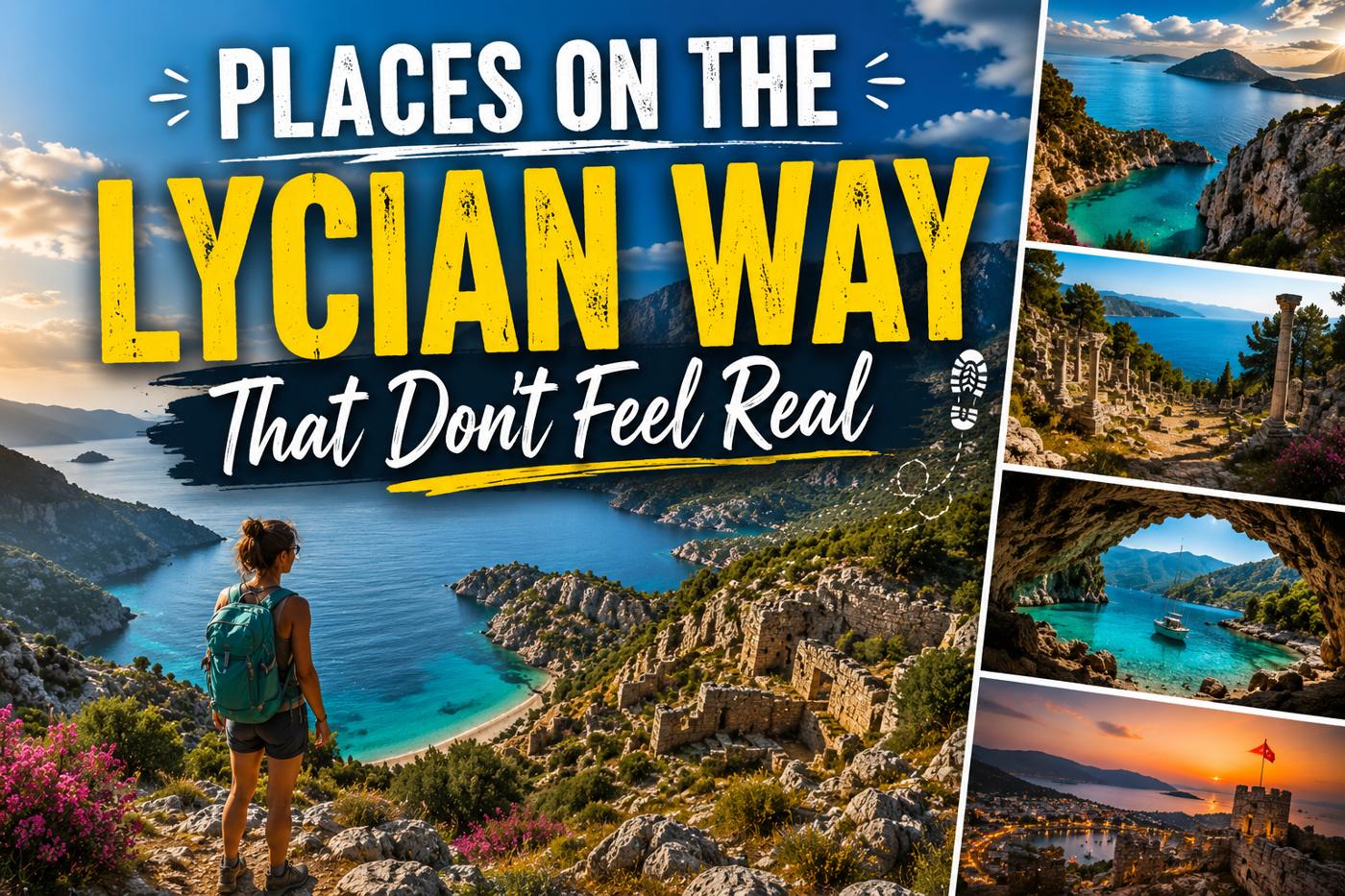
Places on the Lycian Way That Don’t Feel Real
Some hiking trails are beautiful.
Some are historical.
Some offer incredible beaches or mountain scenery.
But the Lycian Way feels different.
Stretching along Turkey’s Mediterranean coastline between Fethiye and Antalya, the Lycian Way combines:
- dramatic cliffs
- hidden beaches
- ancient ruins
- mountain villages
- turquoise water
- endless coastal views
in a way that often feels almost unreal.
There are moments on the trail where the scenery becomes so surreal that it no longer feels like ordinary travel.
You stop walking for a second just to look around and think:
“Is this place actually real?”
These are the places that make the Lycian Way unforgettable.
1. Butterfly Valley – A Hidden World Beneath Giant Cliffs
Butterfly Valley is one of the most iconic places on the Lycian Way — and also one of the most unreal.
The first time most hikers see it is from the cliffs above:
a narrow canyon opening toward glowing turquoise water far below.
Massive vertical cliffs surround the valley on both sides, creating an isolated world hidden beside the Mediterranean Sea.
From above, the scenery looks almost artificial:
- electric blue water
- white shoreline
- dramatic canyon walls
- dense greenery
The contrast between the sea and the cliffs becomes almost impossible to photograph accurately.
No picture fully captures how surreal the place feels in real life.
2. The Coastal Cliffs Between Kaş and Aperlai
Some of the most breathtaking scenery on the Lycian Way appears along the coastal sections between:
- Kaş
- Aperlai
- Kekova
The trail follows dramatic cliffs high above the sea while hidden coves appear below in impossible shades of blue.
What makes this area feel unreal is the silence.
You can hike for hours seeing:
- ancient ruins
- tiny islands
- turquoise bays
- rocky coastlines
without encountering another person.
At certain viewpoints, the Mediterranean stretches endlessly into the horizon while the coastline twists beneath steep mountains.
It feels more like a cinematic landscape than a real hiking trail.
3. Kabak Valley – The Mediterranean Jungle
Kabak feels completely different from the rest of the Lycian coast.
Instead of dry rocky terrain, the valley feels almost tropical.
Dense greenery surrounds:
- waterfalls
- mountain paths
- hidden beaches
- wooden bungalows
The contrast between steep mountains and bright turquoise sea creates a surreal atmosphere, especially during:
- sunrise
- sunset
- quiet mornings
At night, the valley becomes almost completely silent except for:
- insects
- waves
- distant wind through the trees
Many travelers arrive planning to stay one night and end up staying far longer.
4. Simena Castle at Sunset
Few places on the Lycian Way feel as magical as:
- Simena Castle
- Kaleköy
- Kekova coastline
during sunset.
The ancient stone ruins overlook:
- tiny islands
- fishing boats
- turquoise water
- mountain silhouettes
As the sun disappears behind the Mediterranean, the entire coastline turns:
- orange
- gold
- deep blue
The atmosphere feels timeless.
Because there are almost no cars and very little modern infrastructure, the area still preserves an ancient feeling rarely found elsewhere.
Standing on the castle walls above the sea genuinely feels unreal.
5. Kaputaş Beach – The Impossible Color of the Water
Kaputaş Beach has become famous online for one reason:
the water color.
But even after seeing photos, most visitors are still shocked in real life.
The beach sits dramatically between steep cliffs and canyon walls, while the sea glows in shades of:
- turquoise
- deep blue
- emerald
that almost look digitally enhanced.
The color comes from underwater springs and sunlight reflecting through the canyon.
Especially during midday, the water becomes so bright that it barely looks natural.
6. The Hidden Ruins of Aperlai
Unlike large archaeological sites crowded with tourists, Aperlai feels forgotten.
The ruins sit quietly beside the sea surrounded by:
- olive trees
- rocky hills
- hidden coastal paths
There are no massive entrances or commercial tourist infrastructure.
You simply arrive after hiking through Mediterranean wilderness and suddenly discover:
- ancient harbor ruins
- broken stone walls
- submerged structures
beside crystal-clear water.
The silence here changes everything.
It feels less like visiting ruins and more like accidentally discovering a lost civilization.
7. The View Above Ölüdeniz
One of the most famous Lycian Way viewpoints overlooks:
- Ölüdeniz
- Blue Lagoon
- surrounding mountains
The contrast between:
- bright turquoise water
- white beaches
- steep cliffs
- paragliders floating through the sky
creates one of the most surreal coastal landscapes in Turkey.
Especially early in the morning, before crowds arrive, the view feels almost dreamlike.
The sea appears too blue to be real.
8. Olympos – Ancient Ruins Hidden Inside a Forest
Olympos feels like something from another world.
Instead of open archaeological ruins, ancient structures hide inside:
- dense forest
- jungle-like vegetation
- riverside pathways
Stone ruins appear unexpectedly between:
- giant trees
- vines
- flowing water
while the Mediterranean coastline sits only minutes away.
The combination of:
- ancient history
- tropical atmosphere
- beach scenery
makes Olympos one of the most unique places anywhere on the Lycian Way.
9. The Tiny Coves Only Hikers Discover
Some of the most unreal places on the Lycian Way do not even have names.
Small hidden coves appear beneath cliffs along remote sections of the coastline.
Often accessible only by:
- hiking
- kayak
- boat
these beaches remain completely untouched.
Sometimes hikers arrive and realize:
they are entirely alone beside crystal-clear Mediterranean water.
No roads.
No hotels.
No crowds.
Just sea, cliffs, silence, and sunlight.
These unexpected moments often become the strongest memories of the entire journey.
Why the Lycian Way Feels So Different
The Lycian Way is not simply beautiful because of individual locations.
It feels different because of the way everything combines together:
- mountains
- sea
- ruins
- forests
- villages
- history
- isolation
Very few places in the world offer this combination in such a raw and natural way.
The trail constantly shifts between landscapes, making every day feel unpredictable.
One hour you walk through mountain forests.
The next you swim beside ancient ruins.
Then suddenly you arrive at a hidden beach beneath giant cliffs.
That constant contrast creates the feeling that the Lycian Way is somehow unreal.
Best Time to Experience These Places
The best seasons are:
- Spring
- Autumn
Especially:
- April
- May
- October
During these months:
- temperatures remain comfortable
- landscapes become greener
- sunsets improve
- crowds decrease
These conditions make the scenery feel even more dramatic.
Final Thoughts About Places on the Lycian Way That Don’t Feel Real
Some places stay beautiful only in photographs.
The Lycian Way is the opposite.
Photos rarely capture how surreal these landscapes actually feel in person.
Because the real magic is not only in what you see —
it is in the atmosphere:
the silence,
the isolation,
the endless Mediterranean horizon,
and the feeling that modern life suddenly disappeared somewhere behind you.
That is what makes the Lycian Way unforgettable.
And that is why so many travelers leave feeling like they experienced places that simply should not feel real.
You can click here to go on tours.

Comment (0)