
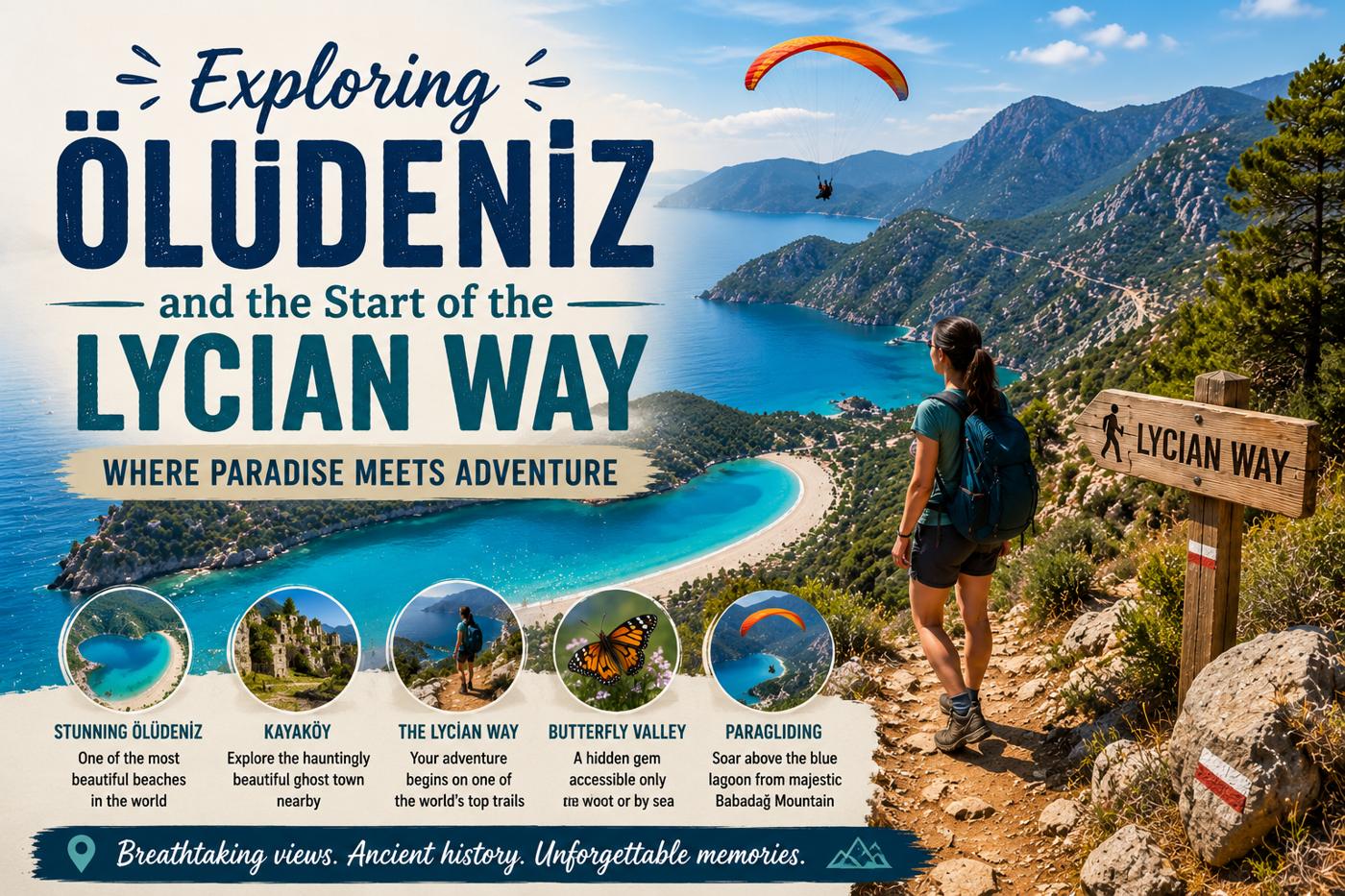
Exploring Ölüdeniz and the Start of the Lycian Way
There are places in the world that look exactly like their photographs.
Ölüdeniz is not one of them.
The photographs are good. The turquoise lagoon, the white pebble beach, the mountains rising behind — you have probably seen the images. They are on the cover of Turkish tourism brochures. They appear in every list of the world’s most beautiful beaches.
But photographs cannot capture the scale of it. The way the colour of the water changes as you move from the open sea into the sheltered lagoon. The mountains reflected on completely still water at first light. The feeling of standing at the edge of all that blue and realising you are about to walk away from it into the hills.
Because this is also where the Lycian Way begins.
What Is Ölüdeniz?
Ölüdeniz — the name means “Dead Sea” in Turkish, a reference to its famously calm, sheltered waters — is a small resort town on the Aegean coast, approximately 15 kilometres south of Fethiye.
It is built around one of the most photographed beaches in the Mediterranean: a long stretch of white pebble and sand bordering the famous blue lagoon, protected on three sides by mountains and open to the sea on one side through a narrow channel.
The lagoon is a national park. Swimming is permitted in designated areas, and the water inside is noticeably calmer and warmer than the open sea.
Above the beach, the mountain of Babadağ rises to nearly 2000 metres. It is the launch point for one of the world’s most popular paragliding sites — on any given day between April and October, dozens of colourful parachutes drift slowly down from the summit toward the beach, landing on the pebbles beside swimmers who barely look up.
It is that kind of place.
Ölüdeniz as the Start of the Lycian Way
The Lycian Way officially begins — or ends, depending on which direction you walk — at Ölüdeniz.
More precisely, the western terminus of the trail is at the nearby village of Ovacık, just above Ölüdeniz. But most hikers begin their walk from the beach itself, climbing up through the resort and into the hills above the lagoon.
The moment you leave the beach behind and start climbing, something shifts.
Within twenty minutes, the resort hotels and souvenir shops disappear. The path narrows to single track. Pine trees close in on either side. The sound of the sea fades. The sound of the wind in the trees takes its place.
You are on the Lycian Way.
The Walk from Ölüdeniz to Faralya
The first major section of the trail from Ölüdeniz leads to the village of Faralya, perched dramatically on a cliff above the Butterfly Valley.
This section is one of the most celebrated on the entire trail — and also one of the most challenging starts. The path climbs steeply out of Ölüdeniz, gaining significant elevation before the terrain eases and the coastal views open up.
The reward for the climb is extraordinary.
From the high path above the coast, the view back over Ölüdeniz is one of the finest on the entire trail. The lagoon from above looks almost artificial — too perfectly blue, too perfectly shaped to be real. The open sea beyond it stretches all the way to the horizon.
Then the path turns east and the views change completely.
Deep gorges dropping to the sea. Rocky headlands extending into the water. The coast stretching away in both directions, completely undeveloped, exactly as it has looked for centuries.
The walk to Faralya takes approximately 4 to 5 hours at a comfortable pace. It is steep in places but well-marked throughout.
Butterfly Valley
From Faralya, a steep path descends to one of the most famous spots on the Lycian coastline: Butterfly Valley.
A narrow gorge cuts through vertical rock walls to a hidden beach completely inaccessible by road. The valley takes its name from the Jersey Tiger butterfly, which gathers here in extraordinary numbers between June and September.
The descent is steep and requires care — some sections involve scrambling over rocks. But the valley below is unlike anywhere else on the coast. No roads. No cars. A waterfall at the back of the gorge. A beach bar that is either charming or baffling depending on your expectations.
Many hikers spend a night here before continuing east on the trail.
Kayaköy — The Ghost Town
A short distance inland from Ölüdeniz, accessible on foot from the trail or by road from Fethiye, is one of the most hauntingly beautiful places in Turkey.
Kayaköy is a ghost town. An entire village of approximately 3,500 stone houses, churches, and civic buildings, abandoned in the early twentieth century during the population exchange between Greece and Turkey, and left to slowly return to the hillside ever since.
The houses have no roofs. The churches still have some of their decoration. Wildflowers grow through doorways and over walls. Goats pick their way between the ruins.
Walking through Kayaköy is a powerful and strange experience. The scale of the place is unexpected — this was a substantial town, not a village, and the emptiness of it carries a weight that is difficult to describe.
Many hikers walk the section from Kayaköy to Ölüdeniz as a half-day introduction to the Lycian Way. The path between them is gentle, well-marked, and passes through beautiful landscape before descending to the lagoon.
Paragliding from Babadağ
Even if you are in Ölüdeniz primarily to hike, it would be a shame to miss the paragliding.
Babadağ is consistently rated one of the world’s top paragliding locations. The mountain rises to 1969 metres directly above the beach. Tandem flights with an experienced pilot take off from the summit and spend 25 to 45 minutes in the air above the coast before landing on the beach.
The views from above — of the lagoon, the Lycian Way coastline stretching east, the mountains of the interior — provide a perspective on the landscape you will be walking through that no map can replicate.
Many hikers find that a paragliding flight on the first day completely changes how they understand the scale and beauty of the trail ahead.
Things to Do in Ölüdeniz
Swim in the lagoon. The designated swimming area inside the lagoon is one of the most beautiful places to swim in Turkey. Calm, warm, extraordinarily clear.
Walk the Blue Cave. A short boat trip or a longer coastal walk brings you to a sea cave where the light through the water creates a vivid blue glow. A short excursion from the beach.
Boat trips. Daily boat trips run from Ölüdeniz to surrounding coves, caves, and beaches inaccessible by road. A good option for a rest day between hiking sections.
Fethiye market. The Tuesday market in Fethiye, 15 minutes by dolmuş, is one of the best weekly markets on the coast. Fresh produce, local food, textiles, and spices in a genuinely local setting.
Sunset from the hillside. The path climbing from Ölüdeniz toward the Lycian Way offers one of the finest sunset views on the Turkish coast. Worth doing even if you are not starting the trail until the following morning.
Where to Stay in Ölüdeniz
Ölüdeniz has a wide range of accommodation — from large resort hotels on the beach to small family pansiyons in the village above.
For hikers, staying slightly above the beach in Ovacık or the hillside above Ölüdeniz has two advantages: it is quieter, and it puts you closer to the trailhead for an early morning start.
The beach hotels are comfortable and convenient for a recovery day after the trail, with direct access to the lagoon. But for the night before you start walking, a smaller guesthouse further from the beach noise makes for a better night’s sleep.
Booking ahead is essential between June and September. Ölüdeniz is one of the most popular beach destinations in Turkey and accommodation fills quickly.
Getting to Ölüdeniz
The nearest airport is Dalaman, approximately one hour by road. Transfers can be arranged through your accommodation or tour operator.
Fethiye, the nearest large town, is 15 kilometres away and connected to Ölüdeniz by regular dolmuş services throughout the day. Fethiye has a bus station with connections across Turkey.
If you are flying from Istanbul, both Turkish Airlines and Pegasus operate regular flights to Dalaman. Flight time is approximately 1 hour 20 minutes.
The Best Time to Start Here
April and May are ideal. The mountains above Ölüdeniz are green, the wildflowers are at their peak, and the lagoon is beautiful without the summer crowds.
September and October are excellent. The sea is at its warmest, the light is golden, and the trail is noticeably quieter than in summer.
June works well — warm enough to swim properly, not yet at peak summer intensity.
July and August are busy and hot. The beach is crowded, accommodation prices are at their highest, and hiking requires very early starts to beat the midday heat. Still worth it — but requires more planning.
Where the Trail Begins Exploring Ölüdeniz and the Start of the Lycian Way
On the morning you start walking, go to the beach before breakfast.
Watch the lagoon in the early light before anyone else is there. The water will be completely still. The mountains above will be turning from grey to gold. A paraglider will drift silently overhead, impossibly high.
Then put on your boots, pick up your pack, and turn your back on the sea.
The Lycian Way starts here.
Five hundred kilometres of coastline, ruins, mountains, and hidden beaches stretching east to Antalya. Ancient tombs in cliff faces. Villages that time forgot. Evenings on terraces above the sea.
All of it starts with a single step away from the most beautiful lagoon you have ever seen.
Explore our Lycian Way tours starting from Ölüdeniz and begin your journey on Turkey’s most spectacular trail.

Comment (0)