
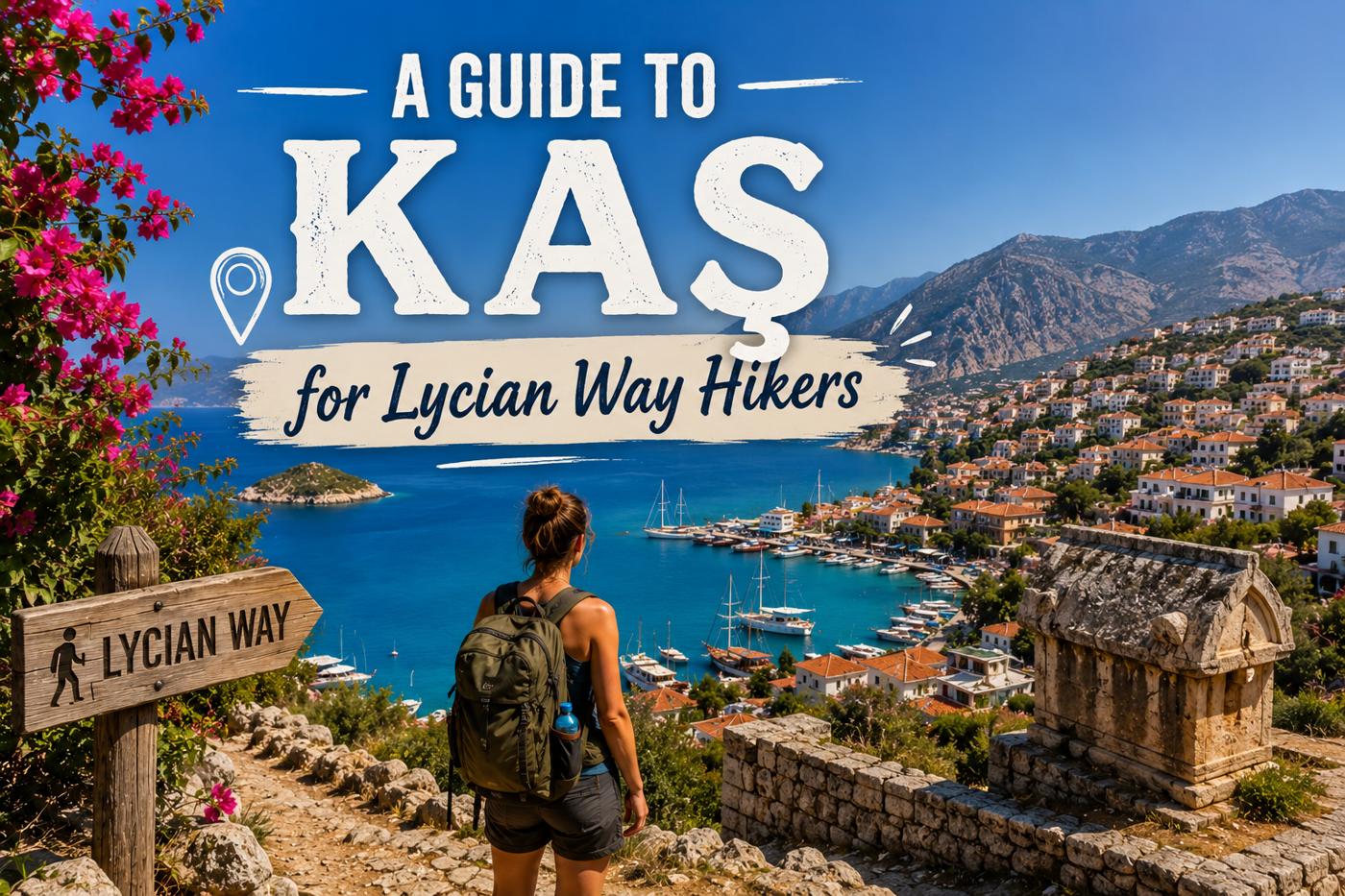
A Guide to Kaş for Lycian Way Hikers
There is a moment, usually on the second or third day of hiking into Kaş, when the town appears below you.
Red rooftops. A small harbour. Bougainvillea spilling over white walls. The Greek island of Meis sitting just four kilometres offshore, so close it looks like you could swim to it.
You stop walking and just look.
Kaş is one of those places that earns its reputation. It is genuinely, quietly beautiful — a small Mediterranean town that has managed to stay itself despite decades of tourism. The streets are narrow and mostly car-free. The pace is slow. The food is excellent. The sea is the kind of blue that makes you want to cancel your return flight.
For Lycian Way hikers, Kaş is also one of the best bases on the entire trail. It sits roughly in the middle of the route, it has good accommodation at every budget, and the walking in both directions from town is some of the finest on the trail.
Here is everything you need to know.
Getting to Kaş
Kaş is not the easiest place to reach — which is part of why it has retained its character.
The nearest airports are at Antalya (approximately 3 hours by road) and Dalaman (approximately 2.5 hours). Both airports have regular connections to Istanbul and to European cities, particularly in summer.
From either airport, the most practical option is a private transfer or a combination of bus and dolmuş (shared minibus). Direct bus services run from both Antalya and Fethiye to Kaş.
If you are joining a guided tour, transfers will typically be arranged for you.
Where Kaş Sits on the Lycian Way
Kaş sits on the southern stretch of the Lycian Way, between Kalkan to the west and Demre (ancient Myra) to the east.
This section of the trail is widely considered among the most spectacular. The coastline here is dramatic — deep bays, rocky headlands, clifftop paths above impossibly blue water — and the ancient sites are numerous and well-preserved.
From Kaş, hikers can walk in either direction:
- Westward toward Kalkan and Patara — passing Lycian tombs, remote beaches, and the extensive ruins of ancient Patara
- Eastward toward Kekova and Demre — one of the most celebrated sections of the entire trail, passing the sunken city of Kekova and the remarkable cliff tombs of Myra
A well-planned 7-day itinerary centred on Kaş covers some of the finest walking on the Lycian Way in both directions.
What to Do in Kaş
Walk the Town
Give yourself at least half a day to simply wander Kaş.
The old town is small enough to explore entirely on foot. The main street runs along the seafront, lined with restaurants, small shops, and cafes. Behind it, narrow lanes climb the hillside past bougainvillea-draped houses, ancient Lycian tombs embedded into garden walls, and small squares where cats sleep in patches of sun.
The Lycian tomb in the middle of town — a monumental fourth-century BC sarcophagus sitting calmly on a street corner — is one of those extraordinary moments where ancient history and everyday life overlap completely.
The Lycian Theatre
A short walk above the town, the ancient theatre of Antiphellos (the Lycian and later Hellenistic name for Kaş) sits in remarkable condition on a hillside overlooking the sea.
The theatre dates from the Hellenistic period — roughly the third or second century BC. It seated around four thousand people. From the upper rows, the view across the bay to the island of Meis is extraordinary.
Entry is free. It is rarely crowded. Going at sunset, when the stone turns gold and the sea goes dark blue, is an experience worth planning around.
Kekova and the Sunken City
The half-day boat trip from Kaş to Kekova is one of the most popular excursions in the region — and it deserves the reputation.
Kekova is a long, narrow island opposite the village of Simena (Kaleköy). Along its northern shore, the ruins of an ancient Lycian city — partially destroyed by a second-century earthquake and then submerged by rising sea levels — are visible just beneath the surface of the water.
Swimming over sunken ruins in clear turquoise water is a genuinely surreal experience.
The boat trip also stops at Simena — a tiny village of about 100 people, built among and on top of ancient Lycian and Roman ruins, accessible only by boat or on foot. A small medieval castle sits above a cluster of Lycian rock tombs. The setting is unlike anywhere else on the coast.
Hikers who walk the Lycian Way eastward from Kaş pass through this landscape on foot — one of the trail’s great privileges.
Diving and Snorkelling
Kaş is one of the best diving locations in Turkey.
The water is exceptionally clear, visibility is high, and there are several interesting dive sites nearby — including underwater ruins, caves, and the famous Russian warship wreck.
For non-divers, snorkelling directly from the rocks near the harbour reveals sea urchins, octopus, and small fish in waters clear enough to see the bottom at considerable depth.
Kayaking
Sea kayaking around the Kaş peninsula and toward Kekova is one of the best ways to experience the coastline.
Several operators run half-day and full-day guided kayaking trips. Paddling into sea caves, stopping to swim from deserted rocks, and seeing the Kekova ruins from the water are experiences difficult to replicate any other way.
Where to Eat in Kaş
Kaş has an excellent food scene for a town of its size.
Breakfast in Kaş is a serious affair. Turkish breakfast — a spread of cheeses, olives, tomatoes, cucumbers, eggs, honey, and fresh bread — is served at most guesthouses and cafes. Take your time with it. You have earned the calories.
Lunch on a hiking day is often simple: a pide (Turkish flatbread with toppings) or a gözleme (thin pastry filled with cheese or vegetables) from a local bakery, eaten on the go or beside the sea.
Dinner is where Kaş really delivers. Fresh fish is excellent and reasonably priced by European standards. Meze — small dishes of dips, vegetables, and seafood — are the right way to start. The local restaurants along the harbour and in the back streets consistently outperform the more tourist-facing places on the main drag.
Ask your guesthouse for their recommendation. They will know where locals eat.
Where to Stay in Kaş
Kaş has accommodation at every level, from simple family-run pansiyons to boutique hotels with rooftop pools.
For Lycian Way hikers, a central location is useful — close enough to the trailhead to start early without a long transfer, and close enough to town to enjoy the evenings.
Pansiyons (family-run guesthouses) are the most characterful option and usually include breakfast. Many are run by families who have hosted hikers for decades and know the trail intimately.
Boutique hotels in the old town offer more comfort and often better views. Rooftop terraces with views over the harbour are common and worth seeking out.
Booking in advance is strongly recommended between April and October, particularly around public holidays.
Practical Information
Getting around: Kaş town centre is entirely walkable. For access to trailheads outside town, dolmuş services run regularly to nearby villages, or your guide or guesthouse can arrange transfers.
Money: There are several ATMs in town. Most restaurants and hotels accept card payment, but smaller shops and market stalls are often cash only.
Shopping: Kaş has a good selection of small shops selling local honey, olive oil, spices, and handmade goods. The weekly market (Friday) is worth visiting for fresh produce and local food.
Mobile signal: Good throughout the town. Signal on the trail sections near Kaş is variable — reliable on high ground with clear views, patchy in valleys and forested sections.
Medical: There is a small hospital and pharmacy in Kaş. For serious medical issues, the nearest major hospital is in Antalya.
The Best Time to Visit Kaş
April and May are the finest months. The wildflowers are at their peak, temperatures are ideal for hiking, and the town is busy but not overwhelmingly so.
June is excellent — warm enough to swim comfortably, not yet at peak summer heat.
July and August are hot and busy. The town fills with Turkish and European summer visitors. Hiking in the midday heat requires care. The sea, however, is at its warmest and most inviting.
September and October are arguably the best months of all. The summer crowds have thinned, the temperatures have eased, the sea is still warm, and the light on the coast in autumn is extraordinary.
November to March is quieter. Some restaurants and guesthouses close. The hiking is still possible and often beautiful, but the town has a more local, low-key feel.
Final Thoughts About The A Guide to Kaş for Lycian Way Hikers
Most hikers who pass through Kaş intend to spend one night.
Many end up staying longer.
There is something about the place — the scale of it, the light, the way the sea looks from the hillside above town, the ease of an evening spent eating well and watching the harbour — that makes leaving harder than expected.
The Lycian Way will still be there in the morning.
The terrace, the cold drink, the view across to the Greek island in the fading light — that is harder to walk away from.
Explore our Lycian Way tours based in and around Kaş and see why this stretch of the trail is one of our favourites.

Comment (0)