
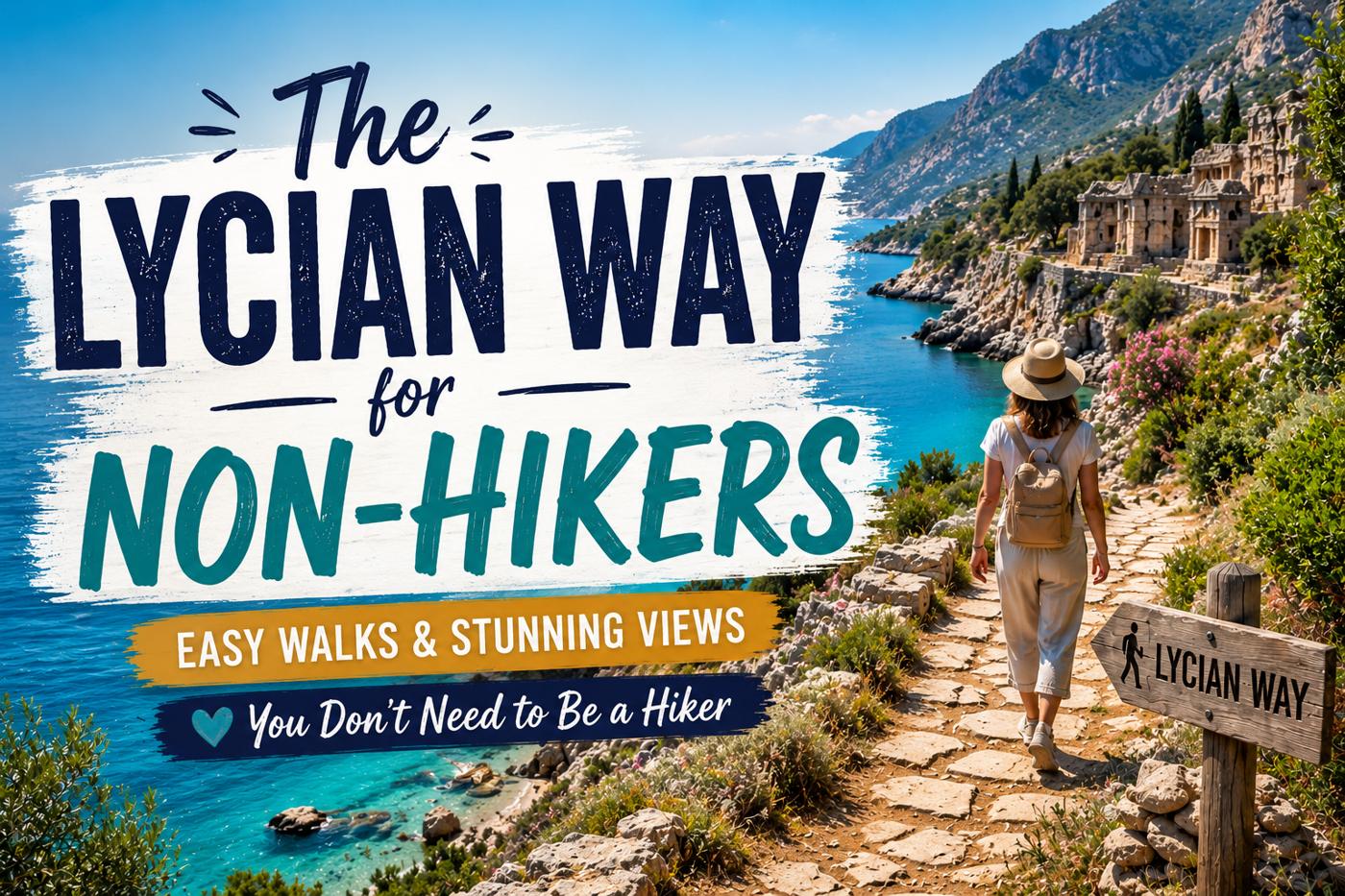
The Lycian Way for Non-Hikers: Easier Sections Anyone Can Walk
When people hear “Lycian Way“, they often picture serious hikers.
Worn boots. Heavy backpacks. Gruelling mountain climbs under the Turkish sun.
And yes — parts of the trail are genuinely challenging. Rocky ascents. Steep descents. Long exposed sections with no shade.
But here is what most people do not know:
A significant part of the Lycian Way is walkable by almost anyone.
You do not need to be a hiker. You do not need special equipment. You do not need to be particularly fit.
You just need comfortable shoes, a bottle of water, and a willingness to slow down and look around.
The Lycian Way Is Not One Trail — It Is Many
This is the thing that surprises most people.
The Lycian Way is 540 kilometres long. It passes through dramatically different landscapes — high mountain ridges, remote coastal cliffs, gentle valley paths, ancient ruins, and sleepy fishing villages.
Some sections are hard. Some sections are easy. And some sections are so beautiful and so gentle that they feel less like hiking and more like a very pleasant walk with extraordinary views.
The key is knowing which sections are which.
What Makes a Section “Easy”?
On the Lycian Way, an easy section typically means:
- Mostly flat or gently rolling terrain
- Well-marked paths with clear surfaces
- Shorter daily distances (8 to 12 kilometres)
- Villages or cafes along the way for rest stops
- Accessible start and finish points by road
These sections are perfect for:
- People who enjoy walking but do not consider themselves hikers
- Families with older children
- Anyone recovering from injury or returning to exercise
- Travellers who simply want to experience the trail without the physical challenge
- People who want to spend more time looking at ruins and swimming than climbing mountains
The Easiest and Most Beautiful Sections
Kayaköy to Ölüdeniz
This is one of the most popular walks on the entire Lycian Way — and for good reason.
The route passes through Kayaköy, a hauntingly beautiful ghost town of abandoned stone houses that has been frozen in time since the early twentieth century. Wandering through the ruins requires almost no effort and rewards you with one of the most atmospheric places in Turkey.
From Kayaköy, the path descends gently toward the famous lagoon at Ölüdeniz — one of the most photographed beaches in the Mediterranean.
The walk takes around 2 to 3 hours at a relaxed pace. The terrain is mostly well-maintained path and gentle track. The views of the turquoise water below as you approach Ölüdeniz are genuinely breathtaking.
This section works beautifully as a standalone day walk, with transport easily arranged at both ends.
Around Kaş
The town of Kaş is one of the most charming bases on the Lycian Way — and the walking around it is gentle enough for almost anyone.
Short sections of trail connect the town to nearby Lycian tombs, hidden coves, and ancient ruins that appear with almost no effort.
One of the most accessible and rewarding walks is the path to the sunken city of Kekova — a stretch of ancient ruins that slipped into the sea centuries ago and can now be seen through crystal clear water from the shore.
The paths around Kaş are mostly flat, well-marked, and passable in ordinary trainers.
Patara Beach Walk
Patara is home to what is often described as the longest beach in Europe — an uninterrupted stretch of sand that goes on for nearly 18 kilometres.
The walking here is about as gentle as it gets. The beach itself is car-free (protected as a nesting ground for loggerhead turtles), meaning the only way to experience it is on foot.
You can walk the full length or simply wander as far as you like before turning back.
At the northern end of the beach lie the extensive ruins of the ancient Lycian city of Patara — the birthplace of Saint Nicholas, and one of the most important cities in the ancient world. Exploring the ruins involves very little climbing and a great deal of wandering through extraordinary history.
Çıralı and the Chimaera
Çıralı is a small, low-key village on the southern stretch of the Lycian Way — the kind of place where time moves differently.
The beach is long, quiet, and fringed with orange trees. The sea is clear. The pace of life is slow.
From Çıralı, a gentle uphill walk of about 45 minutes leads to one of the most extraordinary natural phenomena in Turkey: the Chimaera — natural flames that have been burning from the rock face for thousands of years. Ancient sailors used them as a lighthouse. The Greeks believed this was the entrance to the underworld.
The path to the Chimaera is steep in places but short, and the reward is unlike anything else on the trail.
The ruins of the ancient city of Olympos lie just south of Çıralı, reachable on a completely flat path through a river valley thick with vegetation. Walking among the ruins feels like pushing through a forgotten world.
Faralya and the Butterfly Valley Viewpoint
Faralya is a small village perched dramatically above the coast, reachable by road and connected to the trail by a short section of path.
The walk to the viewpoint above Butterfly Valley requires very little effort and delivers one of the most spectacular views on the entire Lycian Way — a deep gorge dropping straight down to a hidden beach far below, surrounded by vertical rock walls.
In spring and summer, the valley is home to hundreds of species of butterfly. In any season, the view is extraordinary.
This is a walk of perhaps 20 minutes from the village — entirely manageable by anyone.
Tips for Walking the Lycian Way as a Non-Hiker
Start in the morning. Even on easy sections, the midday heat between June and September can be intense. Starting at 7 or 8am means the hardest part of the walk is done before the sun reaches full strength.
Wear proper footwear. You do not need hiking boots on most easy sections, but decent trainers or walking shoes with grip make a real difference on rocky ground. Sandals are not recommended.
Carry more water than you think you need. Villages and cafes appear along most easy sections, but water sources can be far apart on some stretches. One litre per person per two hours is a safe minimum.
Take your time. The Lycian Way is not a race. The slower you walk, the more you notice — ancient inscriptions in rock faces, wild tortoises crossing the path, hidden coves visible only from the right angle. Speed is the enemy of this trail.
Don’t worry about getting lost. The trail is marked with red and white painted waymarks on rocks and trees. On the easier, more popular sections, the path is very clearly signed.
Final Thoughts About The Lycian Way for Non-Hikers
The Lycian Way has a reputation for being a serious hiking trail.
In some places, it is.
But it is also one of the most beautiful, most historically rich, and most rewarding walking routes in the world — and significant stretches of it are accessible to anyone who can walk a few hours at a comfortable pace.
The turquoise water. The ancient ruins. The village tea gardens. The hidden beaches.
None of these things require special fitness or special equipment.
They just require showing up.
Explore our Lycian Way tours — we design every itinerary around your pace and ability, so the trail works for you, not the other way around.

Comment (0)